

Key Takeaways
- Spot Bitcoin ETFs allow institutional investors to gain exposure to Bitcoin through traditional brokerage accounts.
- Regulated Bitcoin ETFs are now managing more than $105 billion in assets.
- To protect investors, custodians keep the underlying assets in offline cold storage wallets.
- Spot Bitcoin ETF inflows have surged in recent months, reaching $57.11 billion as of September 2026.
- Investors can also purchase Bitcoin ETFs using long-term retirement accounts.
Spot Bitcoin ETFs have expanded over the past few years to become some of the most relevant financial instruments for investors seeking exposure to Bitcoin. Ten years ago, the Bitcoin market was fully dominated by retail investors. Larger, regulated investors struggled to get access to the broader crypto market. But that’s not the case anymore.
In the following sections of this article, we will explore the best Bitcoin ETFs to buy in 2026, Bitcoin ETF tax rules, and how spot Bitcoin ETF inflows impact the market. The discussion will also center on custodian safety, costs, and the possibilities that these instruments bring to investors.
What is a Bitcoin ETF?
An exchange-traded fund (ETF) is a financial instrument that tracks the price of an underlying asset. A Bitcoin ETF, in particular, tracks the market price of BTC. As ETFs can only be accessed through brokerage accounts, they allow larger investors to gain exposure to an industry that was previously focused mostly on retail investors.
Portfolio managers can now enhance their strategies by adding spot Bitcoin ETFs to their portfolios. Hence, larger investors are now able to benefit from crypto exposure without having to deal with private keys or cold wallets. Finally, spot Bitcoin ETFs operate during standard stock market hours, which fits perfectly with institutional workflows.
The Core Concept: Wall Street Exposure Meets Digital Scarcity
Wall Street, as a representation of traditional financial markets, previously lacked the ability to purchase Bitcoin or cryptocurrencies. The legacy financial system was diametrically opposed to Bitcoin’s proposition of digital scarcity. There are multiple examples of prominent bankers criticizing Bitcoin, showing that there was a strong rejection of its core promises.
As Bitcoin expanded in recent years and reached very high prices, Wall Street firms became interested in offering BTC exposure to investors. Due to this reason, Spot Bitcoin ETF inflows surged drastically. Thanks to this, investors can now efficiently and securely hold Bitcoin in their portfolios, bypassing the risks of securing their private keys.
How an ETF Tracks the Real-Time Price of Bitcoin?
Retail traders purchasing Bitcoin can easily check prices directly through cryptocurrency exchanges. However, spot Bitcoin ETFs do not work in the exact same way. Issuers of Bitcoin ETFs utilize a creation and redemption mechanism that involves an arbitrage loop conducted by authorized participants.
When the price of ETF shares moves higher than the price of Bitcoin, these authorized participants purchase BTC at market price. Then, they swap the BTC for new fund shares and sell them on the stock market. In this way, the price of the ETF comes down and gets closer to the spot price of Bitcoin.
The contrary happens when the price of the Bitcoin ETF drops lower. These authorized participants purchase undervalued shares and redeem them for Bitcoin from the issuer. As fewer shares are available in the market, the price moves higher once again. Hence, this mechanism effectively stabilizes the share price relative to the price of Bitcoin.
Spot ETFs vs Futures ETFs: Key Differences You Need to Know
There is a key difference between Spot and Futures ETFs. Spot Bitcoin ETFs purchase and store the coins directly using regulated custodians. That means that spot ETF issuers own the underlying asset. This is one of the most efficient ways for investors to get direct exposure to Bitcoin without the risk of holding private keys or engaging with retail crypto platforms.
Meanwhile, Bitcoin futures ETFs are derivatives contracts that are cash-settled. These vehicles are also offered to investors through regulated brokerage platforms. Rather than tracking the current spot price of Bitcoin, futures contracts speculate on the future price of the largest digital asset. Considering their operational costs, Bitcoin spot ETFs offer a better alternative than futures for long-term investors.
Key differentiations between Spot ETFs vs Futures ETFs:
- While Spot Bitcoin ETFs buy and hold physical Bitcoin, futures ETFs hold cash-settled derivatives.
- Spot ETFs track, as close as possible, the spot price of the underlying asset. Futures ETFs for Bitcoin follow shifting prices on their contracts.
- Spot Bitcoin ETFs are better suited for long-term holders compared to futures ETFs due to the rollover expenses associated with them.
Bitcoin ETFs vs Direct Bitcoin Ownership
There are fundamental differences between investing in Bitcoin through an ETF and directly buying it. Purchasing an ETF provides access to Bitcoin price movements through traditional brokerage accounts. This is especially important to large and regulated investors who cannot just simply hold Bitcoin themselves.
Although these new financial products are convenient for institutional investors, they follow strict operational rules. As they are offered through brokerage companies, trading hours are restricted to traditional financial market operations. In addition, Bitcoin ETFs don’t grant ownership of the underlying asset and carry management expenses, which can erode returns for long-term holders.
Choosing the right option depends heavily on an investor’s priorities and how each product meets their needs. Direct Bitcoin ownership requires effort to ensure the asset is properly protected and stored. Instead, Bitcoin ETFs will incur ongoing fees and offer fewer opportunities for those looking to engage with the whole cryptocurrency market.
Pros of Buying Through a Traditional Brokerage
As there are benefits to acquiring and holding Bitcoin directly, there are also multiple advantages to doing so through traditional brokerages. The main benefit is the simplified process of getting exposure to Bitcoin and the cryptocurrency market. Investors can manage their existing financial portfolios and add spot Bitcoin ETFs.
Thanks to Bitcoin ETF tax rules, investors can also maximize their tax strategies through IRAs or 401(k)s in the United States. This eliminates the need to interact with traditional cryptocurrency exchanges, manage private keys, and manually report transactions, purchases, and sales.
Finally, Spot Bitcoin ETFs operate under strict regulatory oversight. This is especially suitable for investors who require institutional-grade custody, reporting, and services linked to portfolio management. Therefore, Bitcoin ETFs offer easy exposure to the cryptocurrency market without the complications of doing so without a traditional brokerage.
The Trade-Offs: Management Fees, No Direct Custody, and Trading Hours
Purchasing spot Bitcoin ETFs through traditional brokerage accounts requires investors to consider management fees, the lack of direct custody, and fixed trading hours. This is very different from what a traditional and retail-focused cryptocurrency exchange offers.
Due to the fact that you own shares, you can’t withdraw the underlying asset to a cryptocurrency wallet. That means that if the goal is to self-custody, Bitcoin ETFs are not the most suitable instrument.
Compared to centralized cryptocurrency exchanges and the spot market, trading hours are limited. This increases the risk to ETF holders. If there is volatility in the market during weekends or in the late evening, investors cannot just sell the ETFs when the market is closed. This creates a gap in the price when the market reopens.
Finally, management fees erode ETF returns over time. Investors are paying for convenience by adding Bitcoin exposure to their already existing portfolios without having to worry about all the risks of self-custody. However, management fees will affect profitability in the long term.
Side-by-Side Comparison: Cold Storage vs. Fund Shares
Let’s compare side-by-side cold storage and Bitcoin ETFs.
Asset Control and Custody: With cold storage, there is no third-party risk or dependence on centralized parties. However, this involves understanding how to protect funds, which means that if things are not done correctly, the BTC could be lost forever. Meanwhile, with a Bitcoin ETF, users fully rely on institutional custodial solutions. This takes away their responsibility to control and protect their funds, ensuring that they are fully protected against attacks.
Trading and Market Access: The retail market is always available. It operates 24 hours a day 7 days a week, allowing users to trade and transfer funds at their discretion. This is different from what Bitcoin ETF holders can do. Regulated investors holding ETFs will have to adapt to traditional stock exchange trading hours and will not be able to transfer the underlying asset at will.
Safety Risks: There are multiple risks linked to holding and storing your own Bitcoin. You can lose the private keys and lose access to your physical device. If the setup of a new wallet is not done correctly and the funds are sent to the wrong address, then those funds could be inaccessible. Spot Bitcoin ETF holders are subject to regulatory shifts, fund tracking errors, and other failures linked to the brokerage account.
Costs and Tax Setup: In order to set up a Bitcoin wallet, you have to first purchase a hardware device. This lets you securely hold your digital currencies. However, you will have to report your taxes by exporting transaction data and manually inputting all information into your tax declaration. There are no additional recurring costs for holding your Bitcoin in a hardware wallet. With a brokerage account and holding a Bitcoin ETF, you will have to pay management fees. However, if you already had an existing portfolio, these management fees were already present. Through a traditional brokerage account, you will have automated tax reporting documents to support your tax declaration.
Leading Bitcoin ETFs: Fee Breakdown and Fund Mechanics
Choosing the right spot Bitcoin ETF is not an easy task. Although all of them track the price of Bitcoin, they have different applicable costs and market liquidity. Active traders should look for Bitcoin ETFs that offer deeper liquidity and tighter spreads.
In the next few sections, we will get into the details of the major spot Bitcoin ETFs in the market. We will also go through their expense ratios, the cost of ownership, spot Bitcoin ETF inflows, and more. In this way, you will have a clear view of which the best Bitcoin ETFs to buy in 2026 are.
Major Spot Funds to Watch (IBIT, FBTC, ARKB, and BITB)
As of today, there are four main funds for spot Bitcoin ETFs. They are BlackRock’s iShares Bitcoin Trust (IBIT), Fidelity Wise Origin Bitcoin Fund (FBTC), ARK 21Shares Bitcoin ETF (ARKB), and Bitwise Bitcoin ETF (BITB).
IBIT is the largest Bitcoin ETF fund, holding a Bitcoin share of around 4%. At the same time, they registered spot Bitcoin ETF inflows that exceeded $65.8 billion as of September 2026. FBTC is the second-largest spot Bitcoin ETF fund, with net assets under management of $14.67 billion and a Bitcoin share of 0.88%.
Other spot Bitcoin ETFs, such as ARKB and BITB, have $2.64 billion and $3.07 billion in net assets, respectively. Together, these two funds have a Bitcoin share of 0.35%.
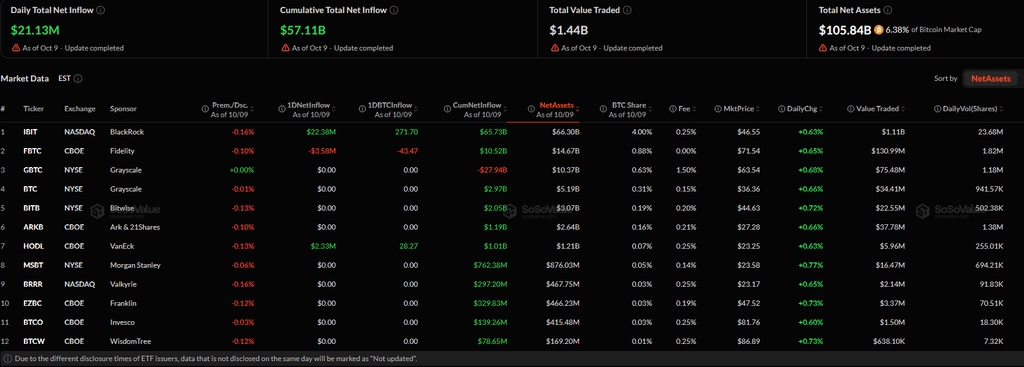
Institutional demand has been growing over the past few years. This has pushed the combined spot fund net assets above $107 billion. Spot Bitcoin ETF inflows, however, remain highly volatile as this depends on market shifts and general macro conditions.
Understanding Expense Ratios and Total Cost of Ownership
Understanding the composition of the fund’s expense ratio is critical before deciding to invest in one of those spot Bitcoin ETFs. However, this only represents part of the true cost of ownership.
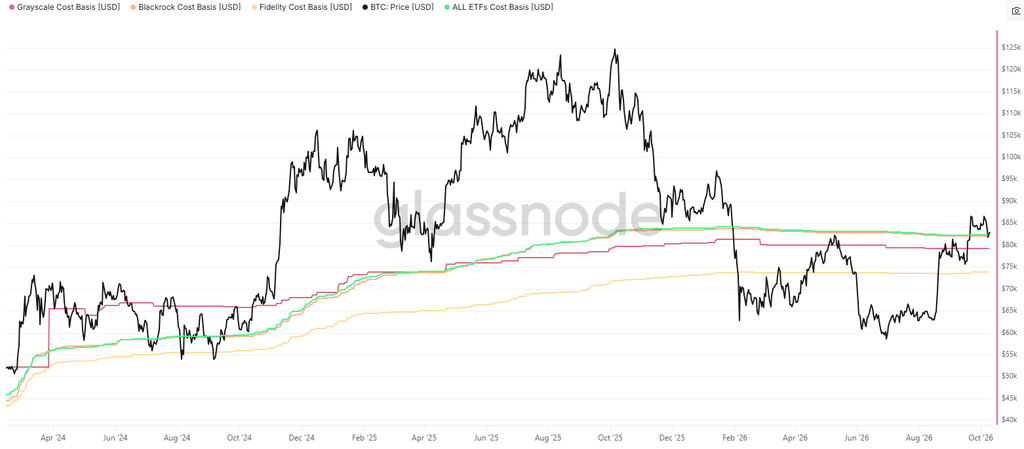
According to Glassnode, annual fees range between 0.15% to 0.25%. Nevertheless, this doesn’t take into consideration trading spreads, which can also add to the costs of managing those ETFs. The best way to avoid large institutional spreads is buying funds with deep trading volume. This allows investors to save every single time they enter and exit a fund.
Smaller ETF funds will have lower annual expense ratios. This might sound attractive to many investors, but it does not account for wider spreads at the time of buying or selling shares. Moreover, smaller providers are usually more prone to tracking errors. It is key to balance management fees and spreads.
Therefore, understanding the expense ratio is important. This will have a large impact on the total cost of managing a spot Bitcoin ETF and how spot Bitcoin ETF inflows behave. Nevertheless, this is not the final cost structure. Spreads are as important as the expense ratio because they will add to the total cost of ownership in the long term.
What Is “Proof of Reserves” and How Custodians Hold the Underlying BTC?
Industry standards have pushed institutions and companies operating in the space to show “proof of reserves.” This is key to determining and verifying that ETF shares are backed by the underlying asset, Bitcoin.
Compared to other retail companies, U.S. issuers are not obliged to publish wallet addresses or real-time transactions showing real Bitcoin holdings. Instead, transparency relies on regulatory filings and audits made to authorities. That’s completely normal and a standard practice among regulated entities operating in the market.
Custodians providing services to ETF providers have very strict operational requirements. As the industry has been affected by multiple hacks and attacks, managing a large part of the Bitcoin supply requires extreme security measures to protect assets. Most of that BTC is held in offline cold storage wallets that require multi-signature in order to move funds.
Spot Bitcoin ETF Inflows and Best Bitcoin ETFs to Buy in 2026
Due to its 0.14% expense ratio, the Morgan Stanley Bitcoin Trust (MSBT) became one of the largest ETFs in the market. This pricing structure aims at aggressively competing against other Bitcoin ETFs providers. Thanks to this strategy, this fund was able to accumulate over $875 million in assets under management.
Meanwhile, other issuers are seeking to gain a larger market share by optimizing fee tiers. Bitwise with its BITB ETF, it reached a cumulative inflow level of $2.05 billion and $3.07 billion in net assets. Compared to MSBT, BITB has a fee structure of 0.20%.
The last two spot Bitcoin ETFs, EZBC and BTCW, have fees of 0.19% and 0.25%, respectively. These are low-friction options that have attracted new investors in recent months. At the moment, they have $466.23 million and $169.20 million in assets under management, respectively.
How to Invest in a Bitcoin ETF (Step-by-Step)
Investing in Bitcoin ETFs is not complex, especially for larger investors who have built a portfolio over time with regulated brokers. Instead of using cryptocurrency exchanges to buy Bitcoin directly, it is possible to gain exposure to spot Bitcoin ETFs using your existing portfolio and a brokerage account.
In the next section, we will guide you step by step on how to invest in a spot Bitcoin ETF. If you follow this guide, you will be able to track the best Bitcoin ETFs to buy in 2026, and understand the Bitcoin ETF tax rules that apply to them.
Step 1: Choose the Right Brokerage Account (Taxable vs. IRA/401(k))
The first thing that you should do is decide between traditional taxable accounts and tax-advantaged solutions like IRAs or 401(k)s. The main benefit of taxable options is the immediate liquidity and unlimited withdrawals. The downside of this type of account is that it will trigger capital gain taxes (depending on the country where the person resides).
Retirement accounts work differently and they are usually aiming at long-term investors. These accounts will reduce the possibilities that users have to manage their funds, but they gains will compound tax-free until retirement.
Step 2: Search by Ticker and Analyze Fund Liquidity
Once you are logged into your brokerage platform, you will have to search for the ticker symbol of the spot Bitcoin ETF you want to purchase. Just take into consideration that some brokerages will not offer all the funds available.
The platform will guide you on the amount you want to invest, the costs of keeping the ETF, and the actual purchase price. You might also be able to set limit orders to purchase the ETF at a specific price. ETFs with larger liquidity will reduce bid-ask spreads.
Step 3: Place Your Order (Market vs. Limit Orders)
As mentioned before, some platforms will let you select between market and limit orders. Market orders will be executed at the best price available at the time of purchase or when the market opens. This is usually a good option for long-term investors who are not worried about daily fluctuations in the price of Bitcoin.
Limit orders, instead, let you set a price at which your order should get executed. If the price reaches the desired level, your order gets filled and the ETF shares become part of your portfolio. This is the best option for investors who want to buy at a lower price and can wait until the price reaches the desired level.
Step 4: Rebalancing Your Target Portfolio Allocation
This will change according to the strategy and desired goals linked to your portfolio. Some investors will prefer a large allocation in ETFs while others would prefer a more conservative portfolio tied to bonds or low-volatility assets.
Bitcoin and cryptocurrencies are highly volatile. Price changes occur on a daily basis and bear markets are common. Therefore, it is key to keep a balanced portfolio and rotate across different assets during large market expansions or corrections.
Bitcoin ETF Tax Rules and Regulatory Safeguards
A proper understanding of Bitcoin ETF tax rules is essential if you want to purchase Bitcoin ETFs. There are substantial differences between using retirement accounts and using your day-to-day portfolio. Hence, let’s get into the details of how Bitcoin ETF tax rules work.

Capital Gains Tax Treatment on ETF Sales
There will be key differences in how Bitcoin ETFs are taxed depending on the jurisdiction where you are located. In the United States, profits resulting from the sale of Bitcoin ETFs are subject to equity capital gains laws. If you hold the asset for a short period of time (less than a year), then you are subject to ordinary income rates. If you hold for a longer period, then lower capital gains taxes will be applied.
Other jurisdictions have more tax efficient regulations. Some countries have 0% capital gains if the ETF is held for a certain period before selling. Examples include Singapore, Switzerland, the UAE, and the Cayman Islands. These jurisdictions don’t have capital gains tax on personal investments and could be better options for long-term holders.
Holding Bitcoin ETFs in Retirement Accounts for Tax Advantages
There are key differences in the United States when holding a Bitcoin ETF in a traditional IRA / 401(k) versus a Roth IRA / 401(k). Using individual retirement accounts shields portfolios from immediate capital gains taxes.
A traditional IRA / 401(k) lets users contribute with pre-tax dollars. Those taxes are deferred until retirement, letting investors grow their portfolios without being taxed annually. Roth IRA / 401(k) contributions are made with after-tax dollars. Portfolio growth and withdrawals are 100% tax free.
SIPC Protection vs. Crypto Asset Insurance Limits
There are different programs that protect ETF investors. For example, the Securities Investor Protection Corporation (SIPC) protects investors up to $500,000 in case a brokerage firm fails. It is worth mentioning that this protection does not apply in case of market fluctuations. The goal is to safeguard custody, not protect against investment decisions.
This is different to what cryptocurrency platforms are currently offering to investors. Most of those exchanges rely on private insurance and in-house asset protection programs. These policies would most of the time protect users against hacks or theft. In the case of bankruptcy, however, court investigations can take years.
Frequently Asked Questions About Spot Bitcoin ETFs
These are some of the most common Spot Bitcoin ETFs Frequently Asked Questions (FAQs). We will address the questions that affect users the most, including the redemption of ETF shares for Bitcoin, exchange insolvencies, and dividends.
Can I redeem my ETF shares for physical Bitcoin?
No. It is not possible for investors to redeem ETF shares for physical Bitcoin. This is only limited to authorized participants. When investors sell their shares, they settle in cash. If your goal is to redeem Bitcoin, then you will have to first sell the shares and transfer the funds to a traditional cryptocurrency exchange to buy BTC.
Are Bitcoin ETFs safe from exchange insolvencies?
Yes. Funds use trust frameworks that protect investors’ capital. The underlying cryptocurrency is held in segregated accounts. If custodians face bankruptcy, creditors cannot seize ETF holdings. This protects investors from counterparty risk. This is different from cryptocurrency exchanges that do not follow the same regulations.
Do Bitcoin ETFs pay dividends or yield?
No. Spot Bitcoin ETFs do not distribute dividends or yield. The growth strategy of Bitcoin and other cryptocurrencies is based on capital appreciation. That means that there will be no interest paid or corporate payouts as there is no entity behind Bitcoin. Returns will only depend on capital appreciation and the long-term evolution of the price of Bitcoin.
More on Bitcoin: Bitcoin hub · Bitcoin price today · Bitcoin price prediction · How to buy Bitcoin safely